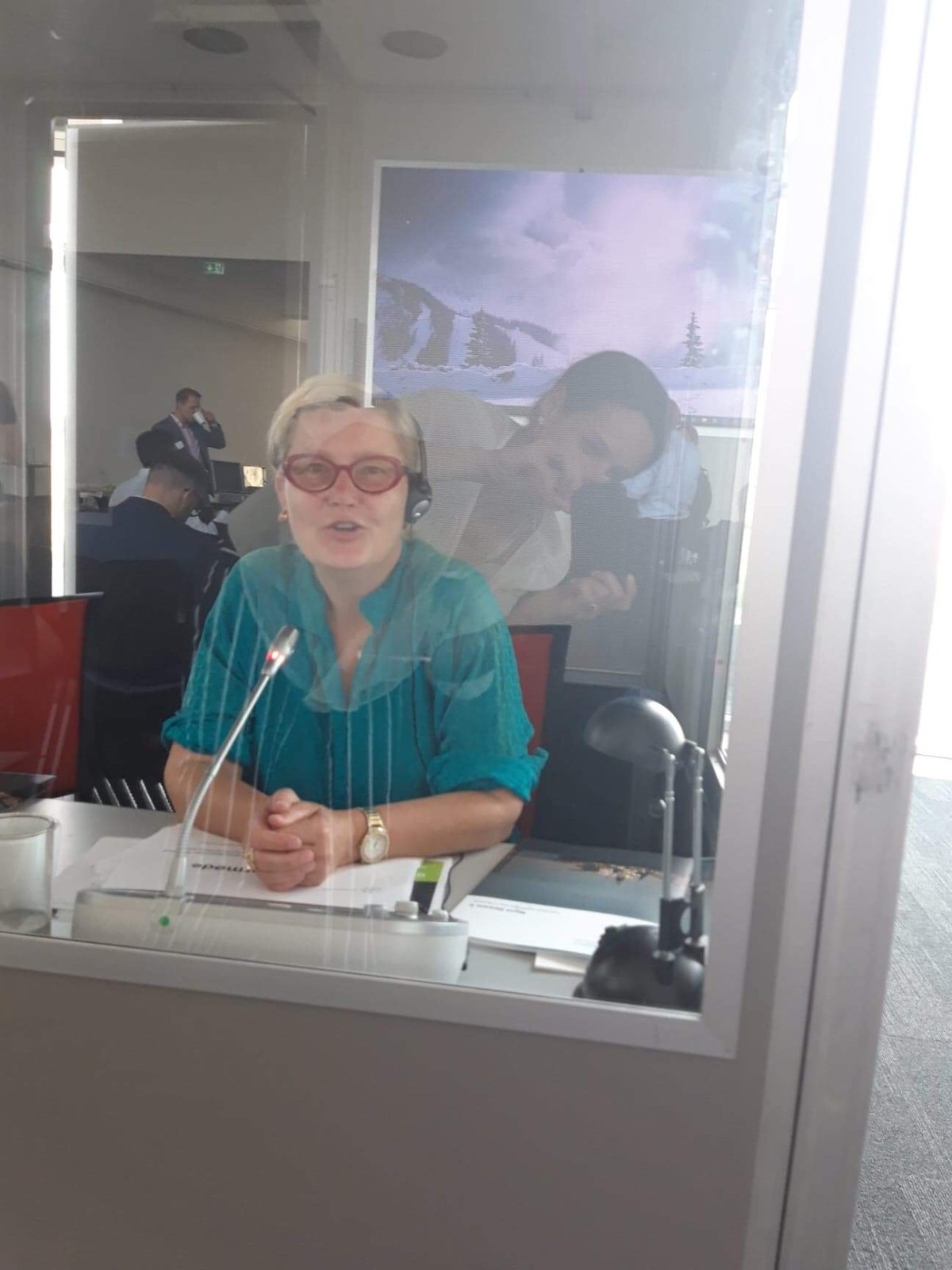
Danish AIIC interpreter
Sara Høyrup works into her Danish native tongue and retour into English and Spanish. She is trained in her retour languages as a philologist and with a European Master's in Conference Interpreting from CBS, as well as a political journalist Master's from a Barcelona university. She is a member of AIIC and an EU-certified ACI. She works all over Europe and beyond. She has lived half her adult life in Barcelona and Seville, Spain. Her current professional domicile is Copenhagen. Sara Høyrup also works from Catalan and German, Swedish and Norwegian, French and Italian. This Danish AIIC interpreter can organise the whole team of simultaneous interpreters in any language combination you need, as well as the necessary technical interpreting equipment. She runs the interpreting agency Tolkene.dk | Interpreters.dk since 2011. She was a legal interpreter in Spain, Denmark and Sweden for 15 years.
Contact Danish AIIC interpreter
Questions
What languages do you interpret into?
What languages do you interpret from?
I interpret into Danish from German.
I interpret into Danish and English from Swedish and (New) Norwegian.
I interpret into Danish and Spanish from Catalan, French and Italian.
What are your ABC-languages? (mother tongue, active and passive languages)
B: English, Spanish (my active languages that I studied in-depth and also work into)
C: German, Swedish, (New) Norwegian, Catalan, French, Italian (passive languages that I only work from)
Where did you train to become a simultaneous interpreter?
How were you certified as a simultaneous interpreter?
Do you have other types of interpreting experience?
Since 2011, I have worked all over the private market in Europe for a wide range of companies and organisations. By private market, conference interpreters mean work outside the public institutions.
What does it mean to be an AIIC interpreter?
It can take a long time from you start working with a language combination, before you add it at AIIC and it shows up at your profile there. This is because you need vast experience in each language combination prior to adding it to your AIIC profile.
AIIC interpreters work mostly as simultaneous interpreters but also as consecutive interpreters. It depends on the meeting set-up which interpreting mode works best.
Can we book a whole interpreting team or several language teams through you?
Conference interpreters call each language team a "booth", because each team works into one language (usually their mother tongue) in a soundproof interpreting booth. If —and only if— we are booked to do so, we also work retour back into one of the other languages involved (or more in very large language settings such as the EU institutions).
The pivot language on the private market in Europe is often but not always English.
Can we book the technical equipment through you?
For all non-mobile events with a large audience, we recommend using the costlier solution, which is the interpreting booth, rather than so-called whispered interpreting on tourguide equipment in a corner of the room. We do so because the booth soundproofs the interpreting somewhat, although not entirely, improving the work conditions and the product, and avoiding mutual noise nuisance.
Can you run the teams during the meeting?
Can we get a discount?
What other costs should we budget for?
We all do require our non-local quality transport covered from our professional domicile, as well as any costs of our separate hotel rooms and decent meals. The latter must either be offered by the client during the event or covered with a subsistence allowance ("per diem").
Where is your professional domicile?
That means that you must reimburse me for my non-local quality transport between that city and your venue, or the equivalent if I happen to travel from somewhere else. You also must cover the last stretch at each end by taxi.
What is the difference between simultaneous and consecutive interpreting?
A consecutive interpreter generally either renders a full verbal translation after the speaker is finished or when the speaker pauses. The full speech form of consecutive interpreting is used for conferences and similar type events. The intermittent form of consecutive interpreting is used for bilateral meetings and course interpreting, as well as community interpreting and other events that work well this way.
Legal interpreting at court is often a combination of the two: whispered simultaneous interpreting to the person that does not speak the language of the court, and consecutive interpreting the other way. The latter is due to the fact that in many countries court interpreters work without equipment that would allow simultaneous interpreting without disturbing the speech flow of that person.
What is a conference interpreter?
Your event does not have to be called or considered a conference to need a conference interpreter. "Conference interpreters" means the highest-end interpreters, trained intensely at university to work in professional settings.
As opposed to community interpreters that need less training, although there is a lot at stake for the citizens they interpret for.
Conference interpreters often work as both simultaneous interpreters and consecutive interpreters, depending on your need. The most used form at professional meetings is simultaneous interpreting.